 Akar Nusa
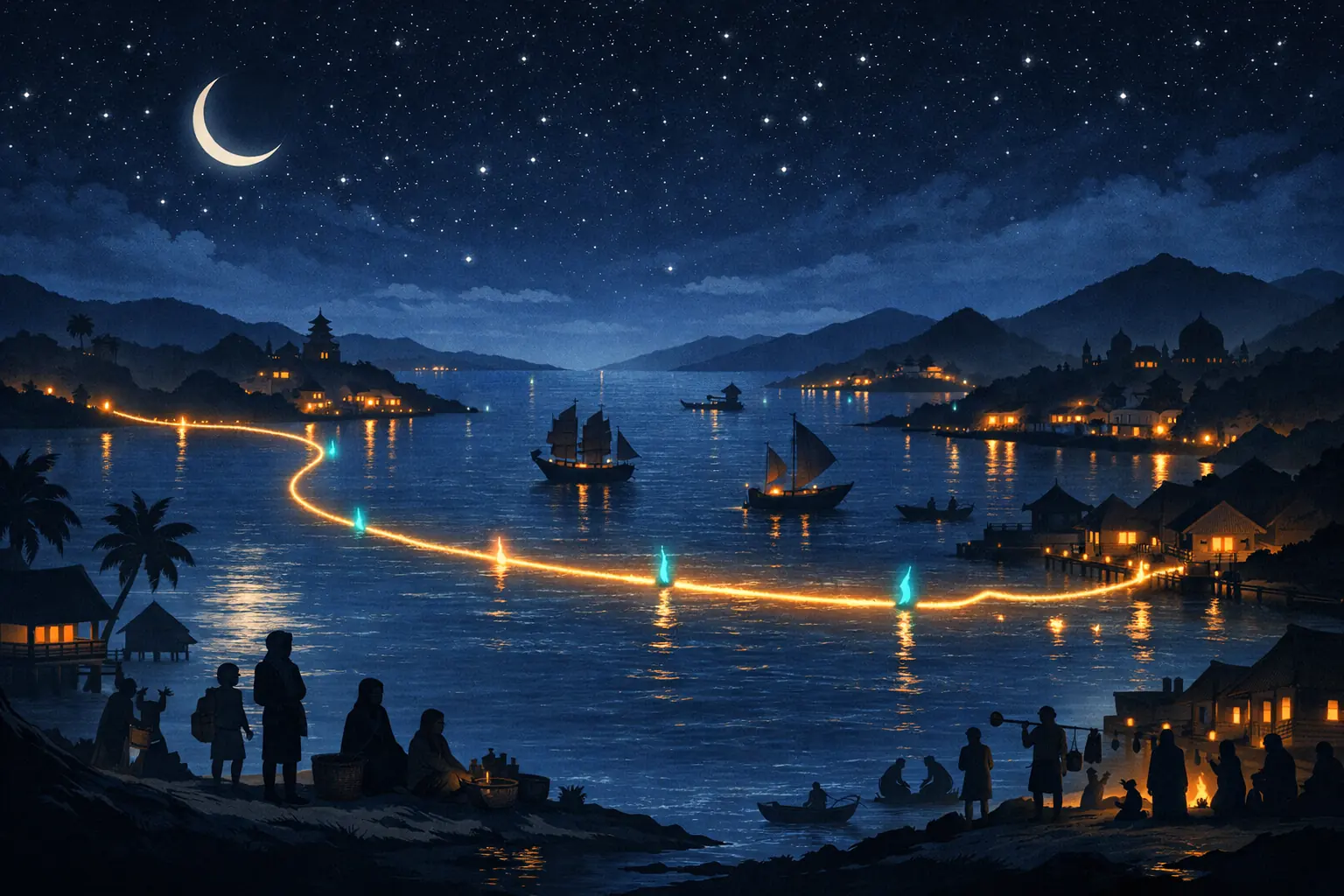
A ship waits for the wind to turn. On the quay, a Chinese ceramic bowl is packed in straw next to a bale of Indian cotton. Nobody there speaks only one language.
The story
The "maritime silk road" was a chain of sea routes linking China, Southeast Asia, India, the Middle East and East Africa. It began by about the 2nd century BCE and flourished until the 15th century CE.
Austronesian sailors built and ran the earliest routes, with sewn-plank ships. Later, Persian and Arab dhows, Tamil merchants and Chinese ships joined in. The goods included ceramics, glass, beads, ivory, fragrant woods, metals, cotton and silk, grain and spices. Camphor was in great demand in China.
The Straits of Melaka was the narrow gate between the Indian Ocean and the South China Sea. Powers such as Kedah, Srivijaya and Melayu competed to host ships. By the mid-15th century the Melaka Sultanate had taken effective control of the Straits. After the Portuguese took Melaka in 1511, trade moved to other ports.
Where you can still see it today
In Penang, Melaka and Kedah's museums, in old ceramics found in wrecks and diggings, in port towns with Chinese temples, mosques and Hindu temples side by side, and in foods that use spices from the islands.
What DNA can tell, and what it cannot
Trade like this made mixing normal. In our family lines, B4 (The seafarers' line) and O-M119 (The seafarers' father line) are linked with sailing peoples of the region. H-M69 (An old line of India) is a father line found in India. These show how threads travel; we do not claim any person's line came by this route. DNA does not decide race, religion or bumiputera status.




