 Akar Nusa
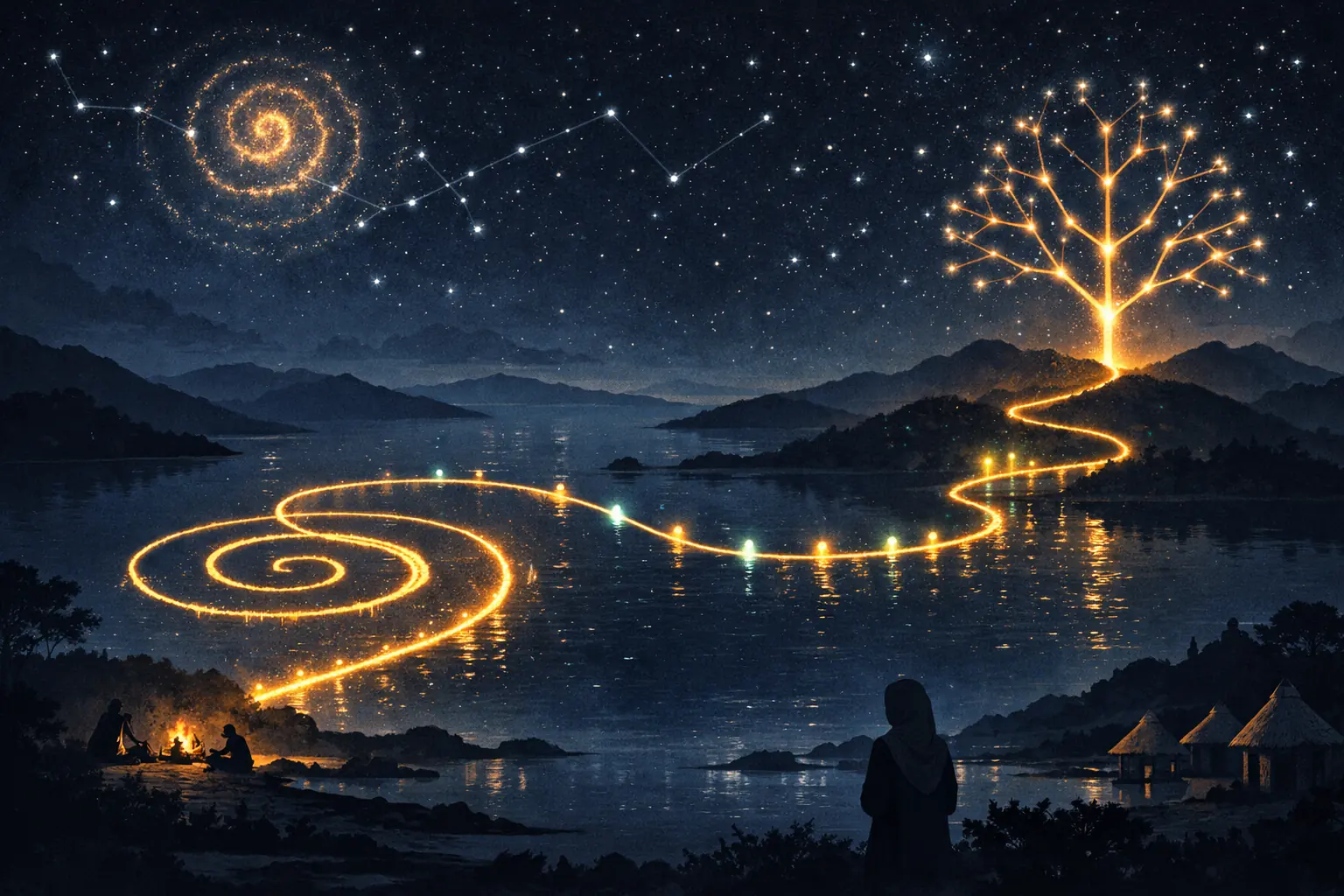
Picture your mother, her mother, her mother's mother, on and on. Each one handed the same small piece of DNA to her daughters and sons. Only daughters could pass it on again.
The story
Inside each cell are tiny power plants called mitochondria. They carry a small ring of their own DNA. You get it from your mother. Your father does not pass his on.
So the ring is copied almost unchanged down the mother line. Now and then a tiny change appears. These changes act like marks on a family tree. Scientists group people who share the same marks into families called haplogroups, named with letters and numbers, such as B4 or M7.
A famous 1987 study read this DNA in 147 people and found that all of it could be traced to one woman who lived about 200,000 years ago, probably in Africa. She was not the only woman alive. Her line is simply the one that has survived through daughters to everyone today. Later work has built a very detailed tree, using more than 8,000 complete mitochondrial genomes.
Where you can still see it today
In your own family, your mother line is the line of mothers: your mother, her mother, and so on. Many families keep a tradition along it: a recipe, a name, a song. DNA adds the very old part of that line.
What DNA can tell, and what it cannot
It can tell your mother-line family, and a general story of where that family travelled. Malaysians we have tested carry many different lines. In our free family lines we tell stories such as B4 (The seafarers' line), M7 (The line of the eastern seas), R9 (An old Southeast Asian line), M21 (One of Southeast Asia's oldest lines), B6 (A line of Southeast Asia) and F1 (The line of the great rivers).
It cannot tell you about your father's side, or your mother's father's side. It is one thread out of thousands. It also cannot say what race or faith you are. See "Why DNA does not prove race, religion or bumiputera status".




