 Akar Nusa
Tamil: the largest Indian community of Malaysia
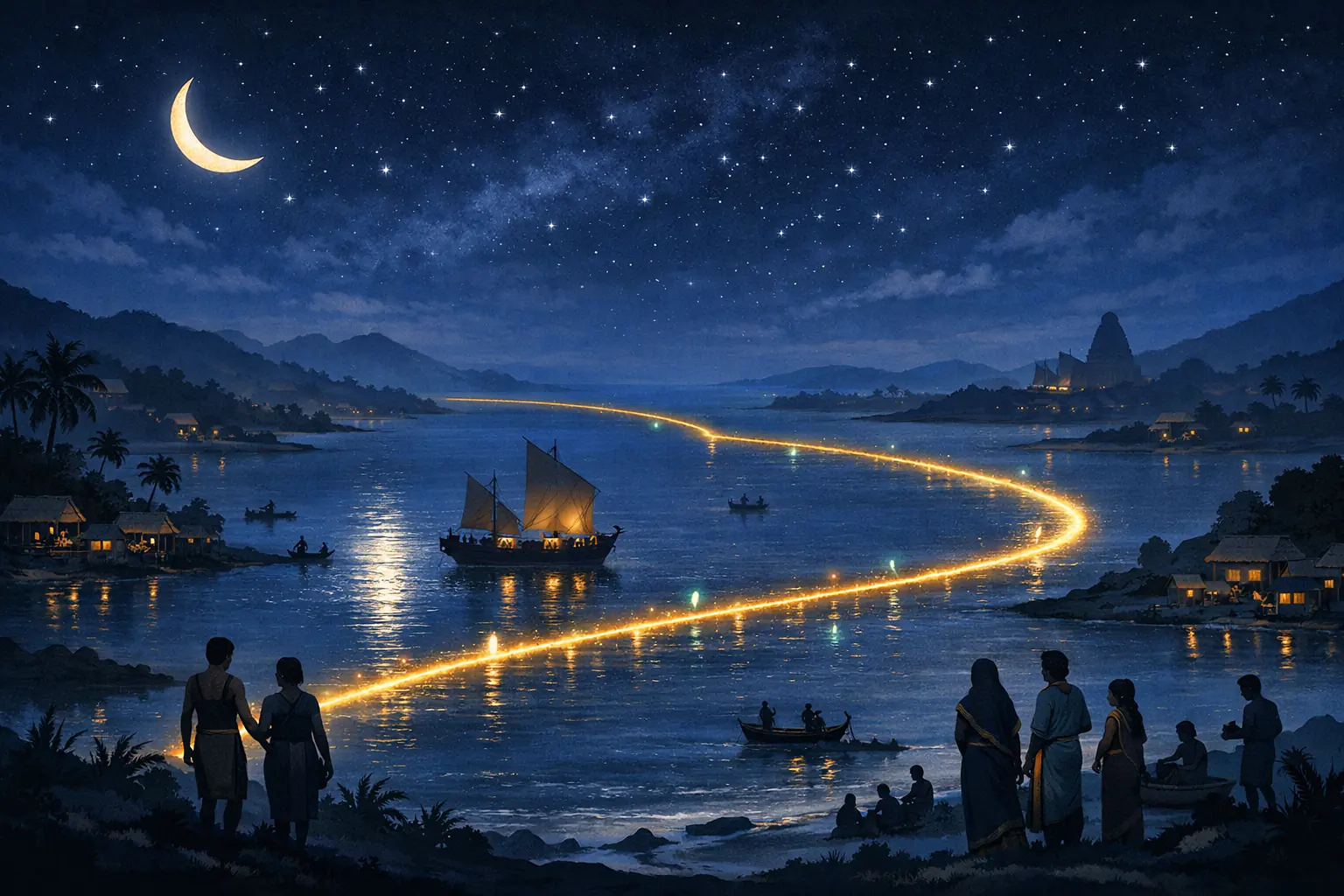
A rubber tapper rises before dawn, lamp in hand, and walks between the rows. Two thousand years earlier, a Tamil trader stood at the shore at Kedah looking at the same sea.
The story
Long before the British. Tamil (தமிழ், Tamil language) poems from about 2,000 years ago are the oldest written records that mention Kedah. Kedah Tua, the old port kingdom in the Bujang Valley, lasted from about the 2nd to the 14th century and was a main stop for Indian traders. Tamil Chola rulers also mention Kedah in their inscriptions. Later, Tamil Muslim traders from the Coromandel Coast (the south-east coast of India) traded through Kedah and Penang, and Tamil traders settled in Melaka (see the Chitty story).
Rubber, and a hard system. In the late 1800s and early 1900s, Malaya's tin and rubber needed workers. Rubber planters recruited Indians, most of them Tamil, from the villages of south India. Until about 1910 many came as indentured workers, meaning they were bound to an employer for a set time. After 1910, men called kanganis (கங்காணி, a foreman or overseer; the word comes from the Tamil for "the one who observes") brought recruits from their home villages. Recruits were often given an advance, and the advance became a debt repaid from small wages. Low pay, debt and isolation on remote estates made life hard.
Many came with their wives and children, because estates needed workers of all ages. The Indian share of Malaya's people rose from 6 per cent in 1901 to 15 per cent in 1921. In the Great Depression of the 1930s, many were sent home. In 1938, India stopped assisted emigration to Malaya.
This was a harsh labour system, designed by the colonial economy of its time. It does not describe the Malaysians of any community today.
Not passive at all. Scholars have shown that estate workers built a life of their own. They raised temples and ran festivals. They asked for Deepavali (தீபாவளி, the festival of lights) advances to be paid earlier. They negotiated for time and resources for thimithi (தீமிதி, the fire-walking festival). They kept their language and schools alive.
Where you can still see it today
- Estate temples and Hindu temples all over the peninsula.
- Tamil schools and Tamil newspapers.
- Deepavali each year, with lamps, sweets and open houses.
- Greetings: "Vanakkam" (வணக்கம், hello) and "Nandri" (நன்றி, thank you).
- Banana-leaf rice, with curries and sambar, eaten by many Malaysians of every community.
What DNA can tell, and what it cannot
A mother line or father line may link to South Asia, and a region estimate may point to south India. This fits the history of Tamil families. But South Asian lines can also reach Malaysia through other routes, such as Melaka traders or Indian Muslim traders. DNA cannot name your caste or religion. Please do not read caste from a test. It cannot do that.
DNA does not decide race, religion or bumiputera status.




