 Akar Nusa
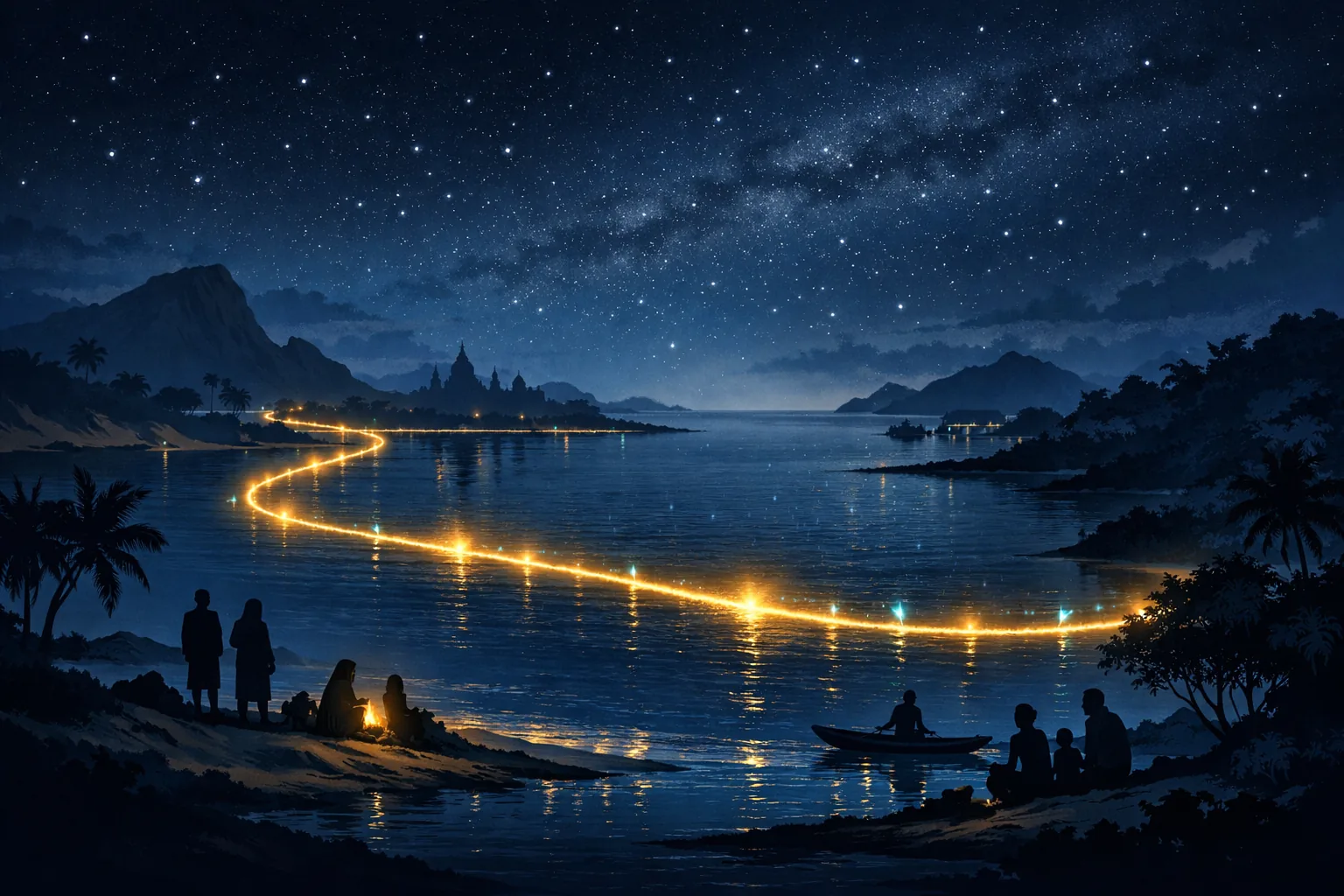
Imagine a family at low tide, walking along a beach that goes on and on. The sea is a different shape from the one we know. There are shellfish in the rock pools and fresh water where a river meets the sand. They keep the sea on one side and the land on the other, and they keep moving.
The story
Scientists who study mother-line DNA have long asked how the first modern humans reached Asia. A team led by Vincent Macaulay looked at the complete mitochondrial genomes of small, old communities in Southeast Asia. They found that these lines support one main dispersal out of Africa, most likely along the southern coast. The route went through India and on into Southeast Asia and Australia. They suggested that the main push from India to Australia took place about 65,000 years ago, and was rapid, probably only a few thousand years.
Why a coast? One reason scholars suggest is that a shoreline is easy to follow and rich in food, though the evidence for how people lived on that journey is thin.
This was also a time when the sea was lower. The region we now call Southeast Asia included a vast land called Sundaland, joined to the mainland. Malaysia sat in the middle of it. People moving along the coast would have found open plains, river valleys and forest.
A 2025 study of a very large set of mitochondrial genomes from Australia, New Guinea and the Pacific supports an early settlement of the Australia and New Guinea landmass, by about 60,000 years ago. That fits a coastal path that passed through our own region, though it does not tell us exactly where.
After the first arrivals, the story of Southeast Asia continued. Hunter-gatherers known to archaeologists as Hoabinhian lived across the region for a very long time. Then, about 4,000 years ago, farming peoples arrived. The Orang Asli stories on this site pick up there.
Where you can still see it today
- In the older lines of today's peoples. Some Orang Asli communities carry very old branches of mother-line DNA. Their stories are told, with respect, in the Orang Asli shelf.
- In a museum. The Lenggong Valley Archaeological Gallery in Perak shows what life was like for early people in the Peninsula.
- On the coast itself. Beaches, mangroves and river mouths along the Straits of Melaka are modern versions of the landscape those families followed.
- At low tide. If you have ever walked a long, flat shore at Port Dickson or Kuantan, you have walked a smaller version of the same road.
What DNA can tell, and what it cannot
The mother line and father line pages show the old branches of the tree that your lines belong to. Many of the old branches that reach Malaysia are very ancient. Some of them probably arrived with these first journeys, but DNA alone cannot say which family walked which beach.
DNA cannot tell you a person's race, religion or bumiputera status. It also cannot say that your family "came from" one single place at one single time. Most people carry threads from several waves of newcomers.
Dates are estimates. Genetic clocks can be wrong by wide margins, so we give ranges and say "about".




