 Akar Nusa
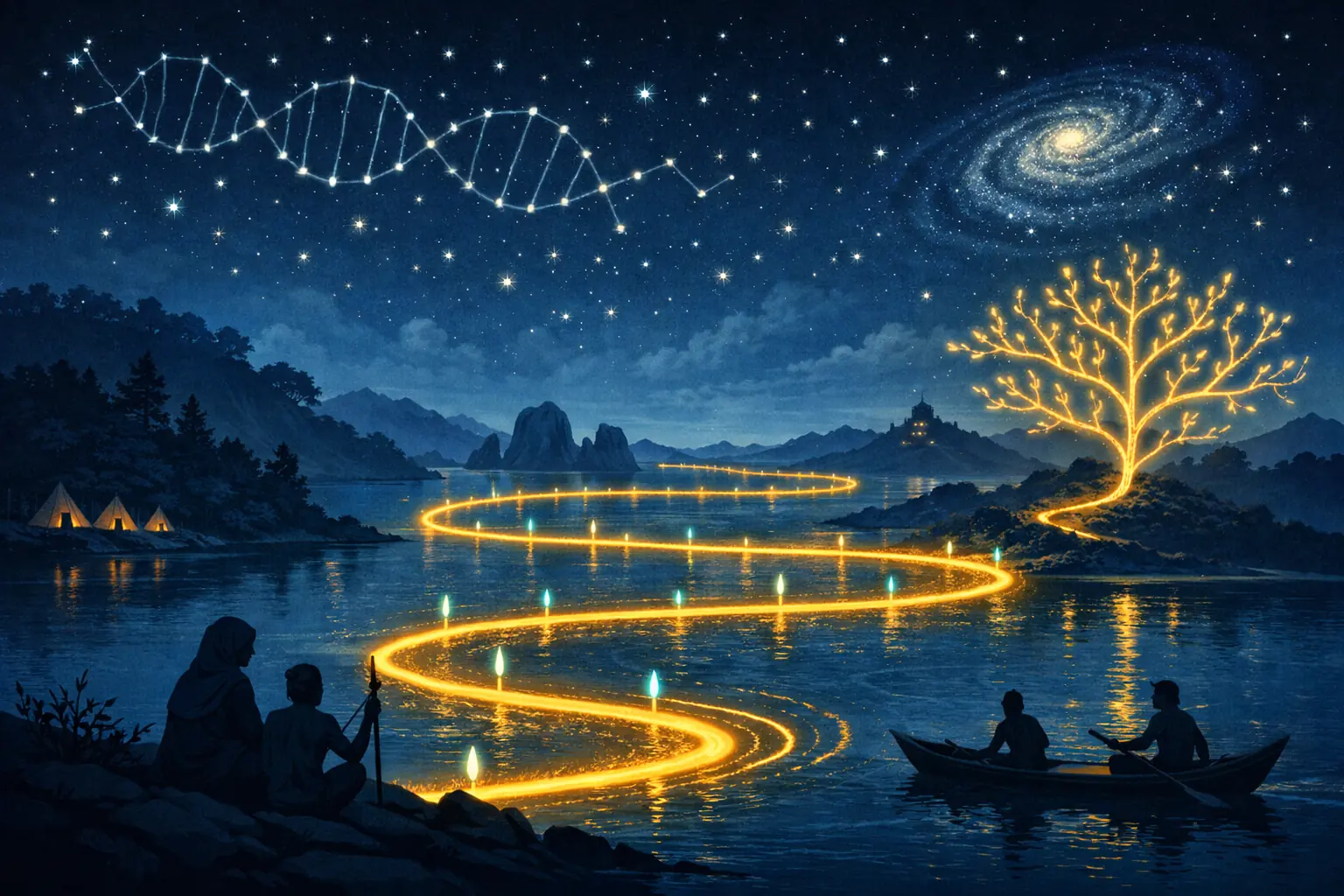
Imagine a long, long rope. Every person in your family tree held one strand of it, and handed a copy of part of it to the next person. A DNA test reads a few hundred thousand tiny marks along your strand.
The story
Your ancestors are the people you come from. Scientists call this ancestry. It is a family map, not a label.
A simple fact helps. Go back ten generations and you have up to 1,024 ancestors in that one row. Go back twenty and the number is above one million. You do not carry a piece of DNA from every one of them. Your DNA is a patchwork, and some ancestors leave very little in it.
An ancestry test does three things. First, it reads your DNA. Second, it compares it with groups of people whose DNA is already known, called reference groups. Third, it tells you which groups you are most similar to.
Scientists who study this point out that "similar to" and "descended from" are not the same. A test result is a statement about similarity. It is a good clue to your family story. It is not a full family tree.
Where you can still see it today
You already know your own family story: the dish your grandmother cooks, the festival your family keeps, the dialect or language at home, the village a grandparent came from. DNA does not replace any of that. It adds one more clue, from the deep past.
What DNA can tell, and what it cannot
- Mother line. Mitochondrial DNA is passed from a mother to all her children. It gives a thread back through your mother's mother's mother. See "Your mother line".
- Father line. The Y chromosome is passed from father to son. Only men carry it. See "Your father line".
- Region estimate. Your whole DNA compared with reference groups. See "Region estimate: how the percentages are made".
What it cannot do: it cannot tell you your race, your faith or your legal status. It cannot name one village or one named person. It also gets less precise when a reference group is small or missing. See "Why DNA does not prove race, religion or bumiputera status".




